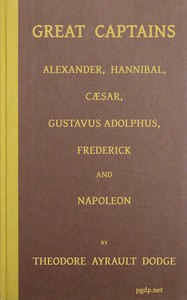
Great captains : A course of six lectures showing the influence on the art of…
Published in 1890, Great Captains by Theodore Ayrault Dodge is a unique piece of historical analysis. It's structured as a course of six lectures, each dedicated to a commander Dodge believed fundamentally reshaped the art of war: Alexander the Great, Hannibal, Julius Caesar, Gustavus Adolphus, Frederick the Great, and Napoleon Bonaparte. Dodge doesn't just narrate their famous victories. He acts as a guide, walking us through their campaigns to highlight the specific innovations—in tactics, logistics, and leadership—that made each man a game-changer for his era.
The Story
There isn't a single narrative plot, but a compelling intellectual journey. Dodge starts with Alexander and his revolutionary use of the combined arms approach, then moves to Hannibal's genius for maneuver and surprise. He shows how Caesar mastered the art of the rapid, decisive campaign, and how Gustavus Adolphus brought mobility and firepower to a new level. Frederick the Great's use of oblique order and disciplined troops gets its due, before the series culminates with Napoleon, whom Dodge saw as the ultimate synthesis of all these earlier lessons. The 'story' is the evolution of military thought itself, told through the lives of these six men.
Why You Should Read It
What makes this book special is Dodge's voice. He was a Union officer who fought in some of the Civil War's bloodiest battles. When he analyzes the stress of command or the chaos of a battlefield, you feel he's writing from experience, not just a library. His opinions are strong and clear—he admires certain traits and scorns others. This isn't a neutral textbook; it's a passionate argument about what effective leadership looks like under extreme pressure. You get a sense of the human cost and the staggering weight of responsibility these 'great captains' carried. It transforms them from distant statues into complex, flawed, and relentlessly driven people.
Final Verdict
Perfect for history buffs who enjoy 'big idea' analysis over simple chronology, and for anyone interested in leadership studies from a very hard-nosed, practical perspective. The 19th-century prose is clear but dense, so it requires a bit more focus than a modern pop-history book. If you enjoy connecting dots across centuries and appreciate an author with a strong, informed point of view, this century-old lecture series still has a lot to teach. It's a thinking person's guide to the minds that built and broke empires.
This book is widely considered to be in the public domain. Distribute this work to help spread literacy.